

Red and near-infrared therapy
For hands that ache, stiffen, or lock up.
Eighty LEDs — forty above your hand and forty below — surround it in red and near-infrared light at 70 mW/cm². Twenty minutes, then it shuts itself off.
Eighty dual-wavelength LEDs
660nm and 850nm together in every single one, at 70 mW/cm².Forty above, forty below
Your hand sits between two full panels, so the light reaches the palm and the back of the hand in the same session.10 Hz pulsed output
Three intensity levels. Most people start on the lowest and stay there.Unzips completely flat
Which is how the same device ends up on an elbow or calf.
Ships within 24 hours — arrives in 5–8 days
4.8/5.0 from 500+ Verified Users
How to use it
Charge the pod, slide your hand in, close the zip. Press once for power, again to set the level. It runs for twenty minutes and shuts itself off with a beep.
Start on level one for the first week, even if it feels like nothing much. Most people settle at level two and use it once in the evening.
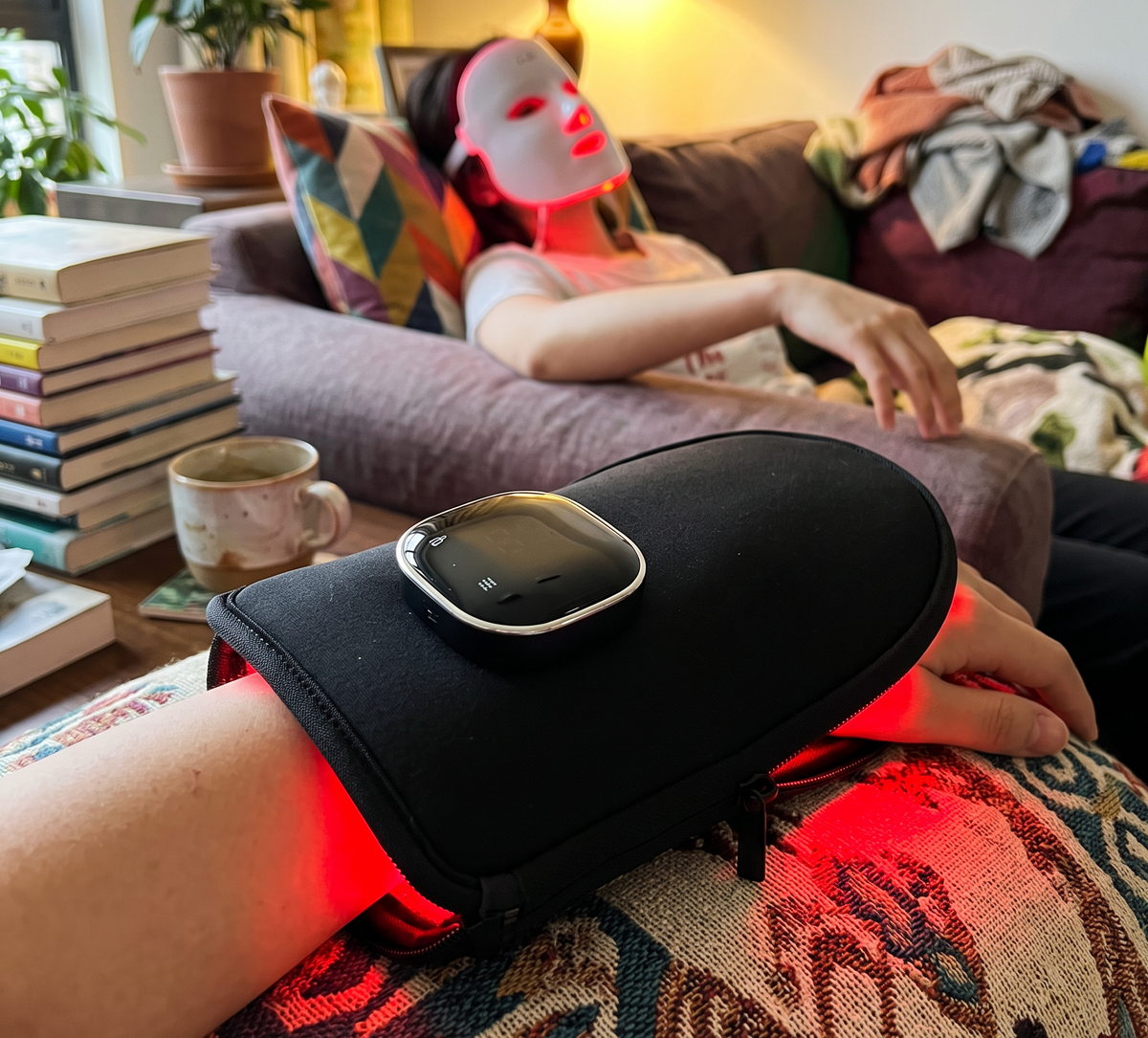
For a calf or elbow: unzip fully, lay the panel against the joint or area — with the device open, the LEDs face outward. Or, wear it like a sleeve and turn it on.
Full specification
LEDs — 80 total, 40 per panel, each emitting 660nm red and 850nm near-infrared simultaneously.
Output — 10 Hz pulsed, three intensity levels.
Session — 20 minutes with automatic shut-off.
Battery — around 60 minutes of use per charge, roughly three sessions. USB-C, cable included.
Fit — one size, ambidextrous, room for large hands. Reaches from fingertips to past the wrist.
Lining — wipe-clean, unzips fully for cleaning.
Shipping and returns
Orders leave within one business day and arrive in 5–8 days, tracked. Free shipping in the US.
Returns. Ninety days to send it back for a full refund, for any reason including “it didn't do anything for me.”
Warranty. Six months as standard, covering faults in the device or the control pod. An extension is available at checkout.
Where it's made
Solera is manufactured in an ISO 13485-certified medical device facility, audited under MDSAP and built to FDA QSR 820 quality standards.
To be precise about what that means: those are the factory's quality credentials, not a clearance for this device. Solera is a general wellness product and it is not FDA cleared. Anyone in this category telling you otherwise is worth a second look.
“It's part of my daily routine now. It helps with the soreness I get from typing all day, and it's easy to alternate hands.”
Watch it open
It doesn't just go on your hand.
The zip runs the whole way round, so the same device folds flat and goes wherever the ache is.
Forty above. Forty below.
Your hand sits between two full panels — forty LEDs above and forty below — so the palm and the back of the joint are lit in the same twenty minutes.
Who it's for
Built for the joints that never get a rest.
Hands work all day and complain at night. These are the situations people most often buy a device like this for.
Thumb and finger arthritis
Stiffness that is worst first thing, joints that catch, and a grip that gives out on a jar lid.
Often described as: osteoarthritis, basal joint, knuckles
Trigger finger and thumb
A finger that locks bent and then clicks as it releases. Usually worse after sleep.
Often described as: stenosing tenosynovitis
Carpal tunnel
Numbness and pins and needles through the thumb and first fingers, often waking people at three in the morning.
Often described as: median nerve compression, night numbness
The one new parents get
Pain at the base of the thumb and along the wrist, from months of scooping up a child the same way.
Often described as: De Quervain's, "mummy thumb"
Cold hands and poor circulation
Fingers that go white or purple in the cold and take far too long to come back.
Often described as: Raynaud's, chilblains, winter stiffness
Hands that work for a living
Trades, keyboards, instruments, handlebars, scissors. Repetition that adds up over decades.
Often described as: RSI, tendonitis, grip fatigue
From people using it
Twenty minutes, most evenings.
My arthritis pain is noticeably better — much less stiffness after a few weeks of using it. Being able to do both hands is a big plus.
I use it after workouts and the difference in how my hands recover is significant. The soothing warmth is exactly what I wanted.
I noticed a difference in circulation within the first week. Easy to swap between hands, and the rechargeable battery makes it convenient.
I had tendonitis in both hands and this has helped a great deal. The warmth and the red light together work well for me.
Bought it for my mum, who has arthritis. She uses it on both hands and the swelling has gone down noticeably.
Two ways to wear it
Drag to open it.
The zip runs the whole way round. Closed, it surrounds a hand. Opened flat, it lays against a knee, an elbow or a foot.
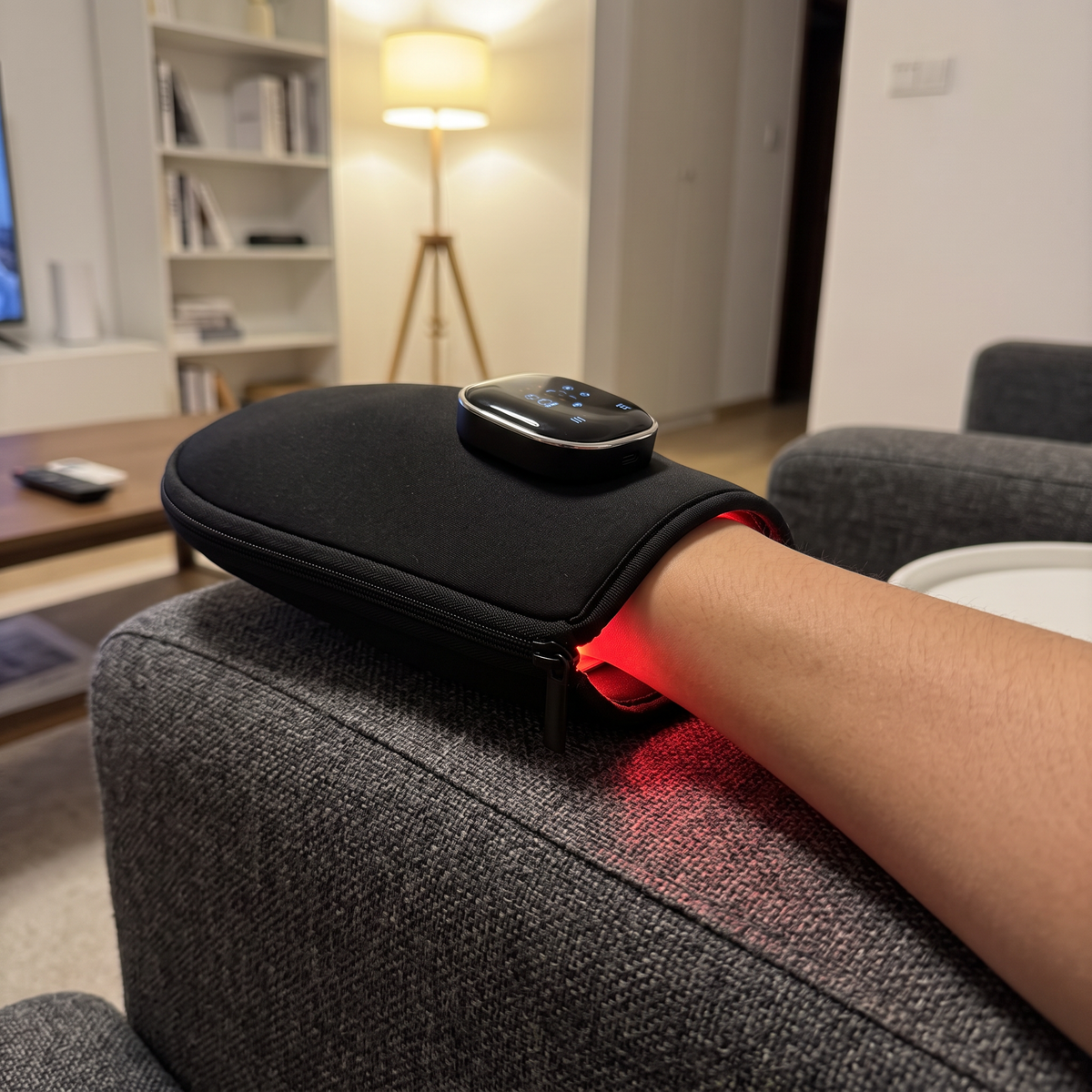
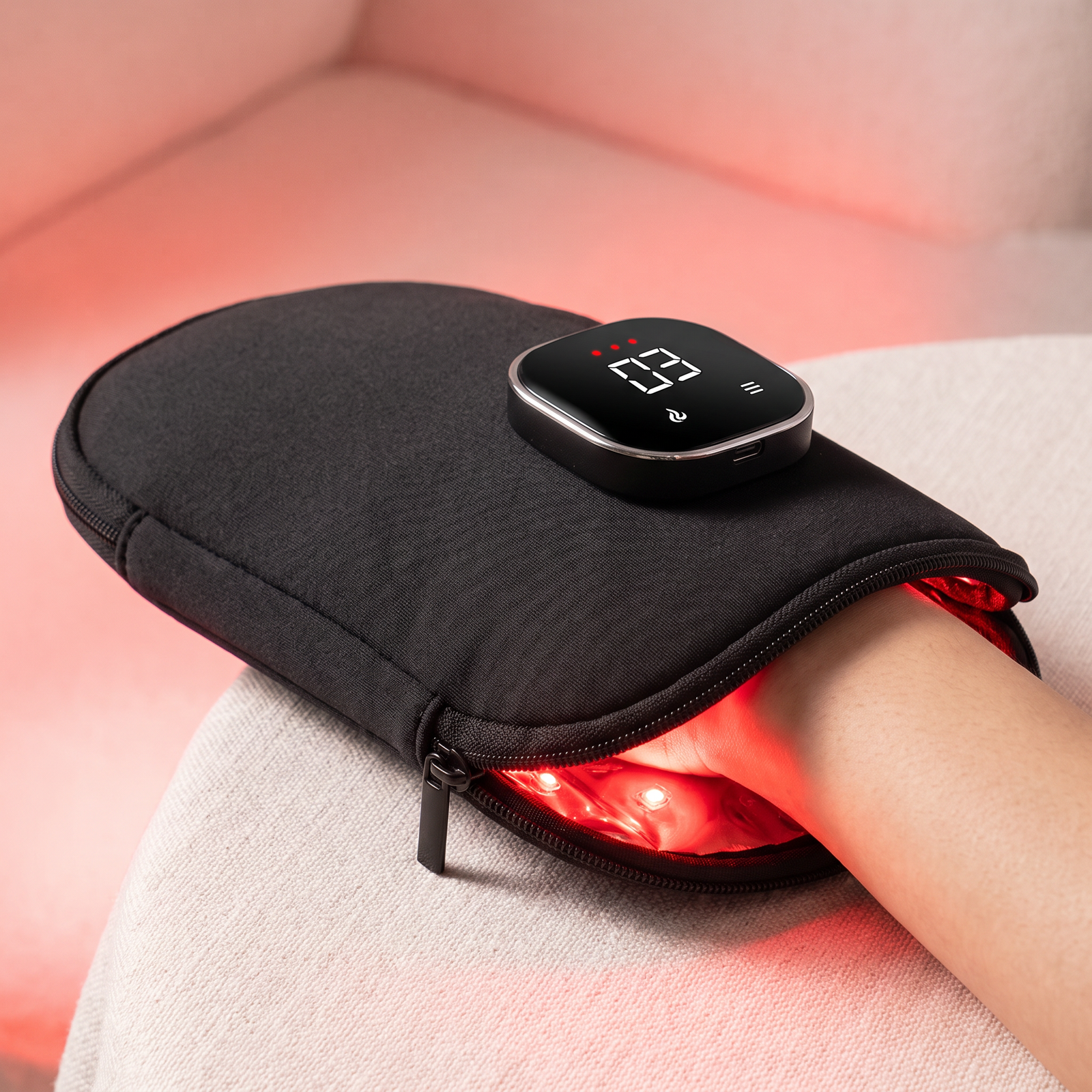
The whole hand, from both sides.
Your hand sits between two panels of forty LEDs. Palm and back at once, fingers included, with nothing to fasten — which matters when fastening a strap is the thing that hurts.
Or a knee. Or an elbow. Or a foot.
Pass your hand through and it becomes a cuff around the wrist and forearm, fingers free. Open it fully and it lays flat over any joint you can reach.
Where it goes
One device. Five places.
Pick a joint and see what the same device does when it's unzipped.
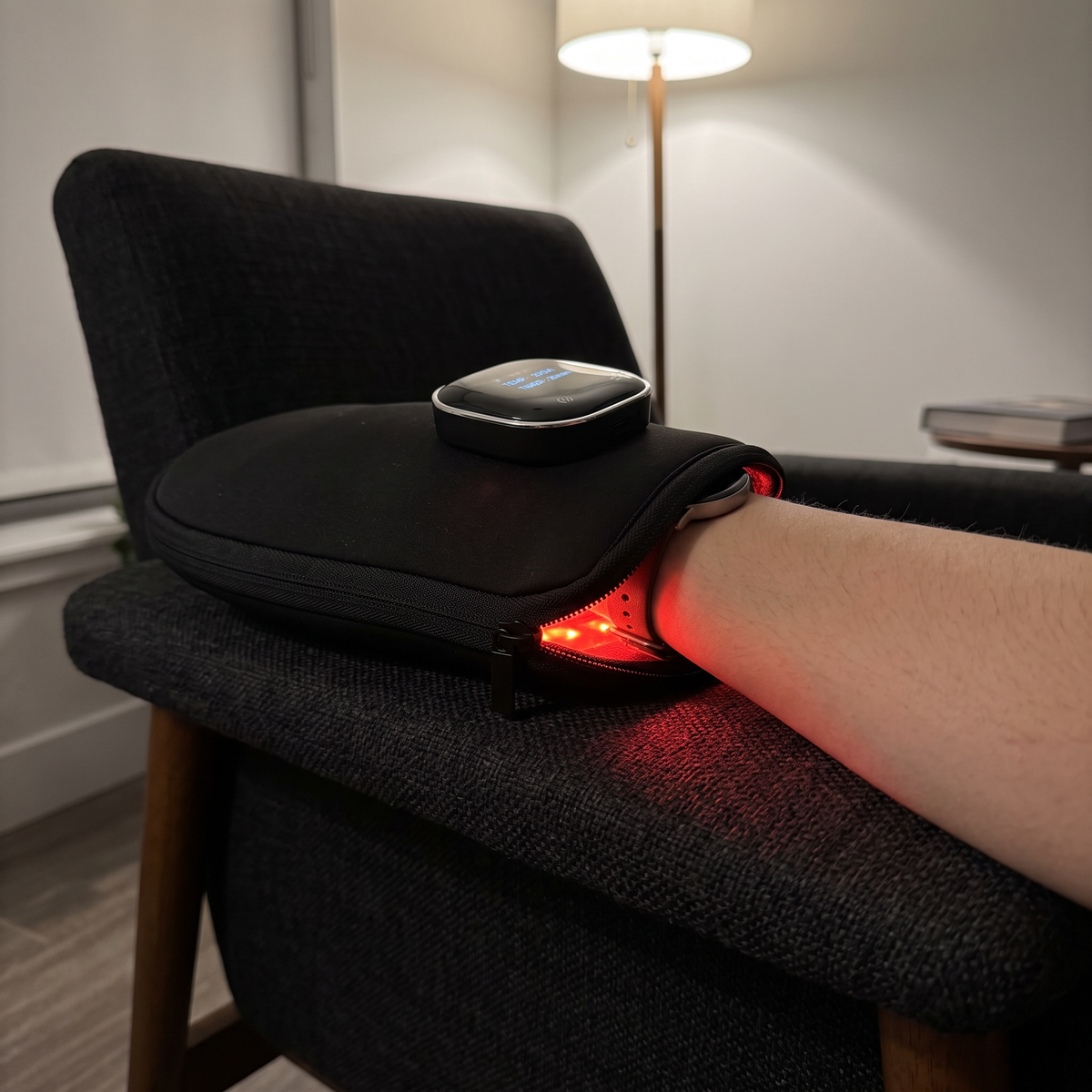
Zipped shut, your hand sits between both panels. Forty LEDs above, forty below, fingers included.
Pass your hand out through the zip and it becomes a cuff. Fingers free — you can type, hold a book, hold a cup.
Unzip the end and slide it over the joint. Reviewers who own red light belts consistently say this beats wrapping one around an elbow.
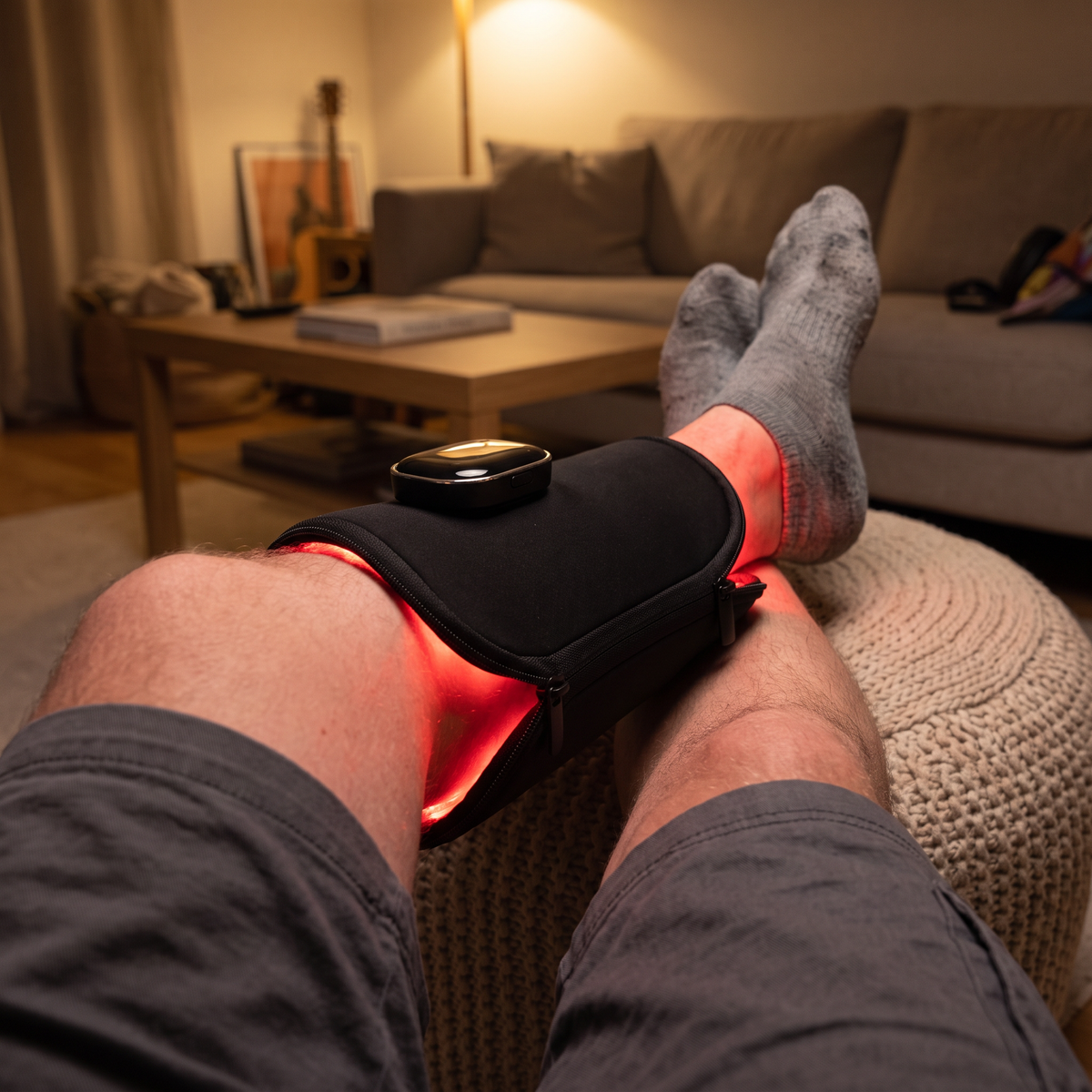
Opened flat, the panel lays across the knee and follows the curve. The most common off-label use by a distance.
The two wavelengths
One you can see. One you can't.
660 nm — visible red
The one that glows.
Red light works close to the surface — skin, and the layer just beneath it. It's also the light you actually see spilling out of the zipper, which is the only reason you can tell the device is on.
850 nm — near-infrared
The one doing the deeper work.
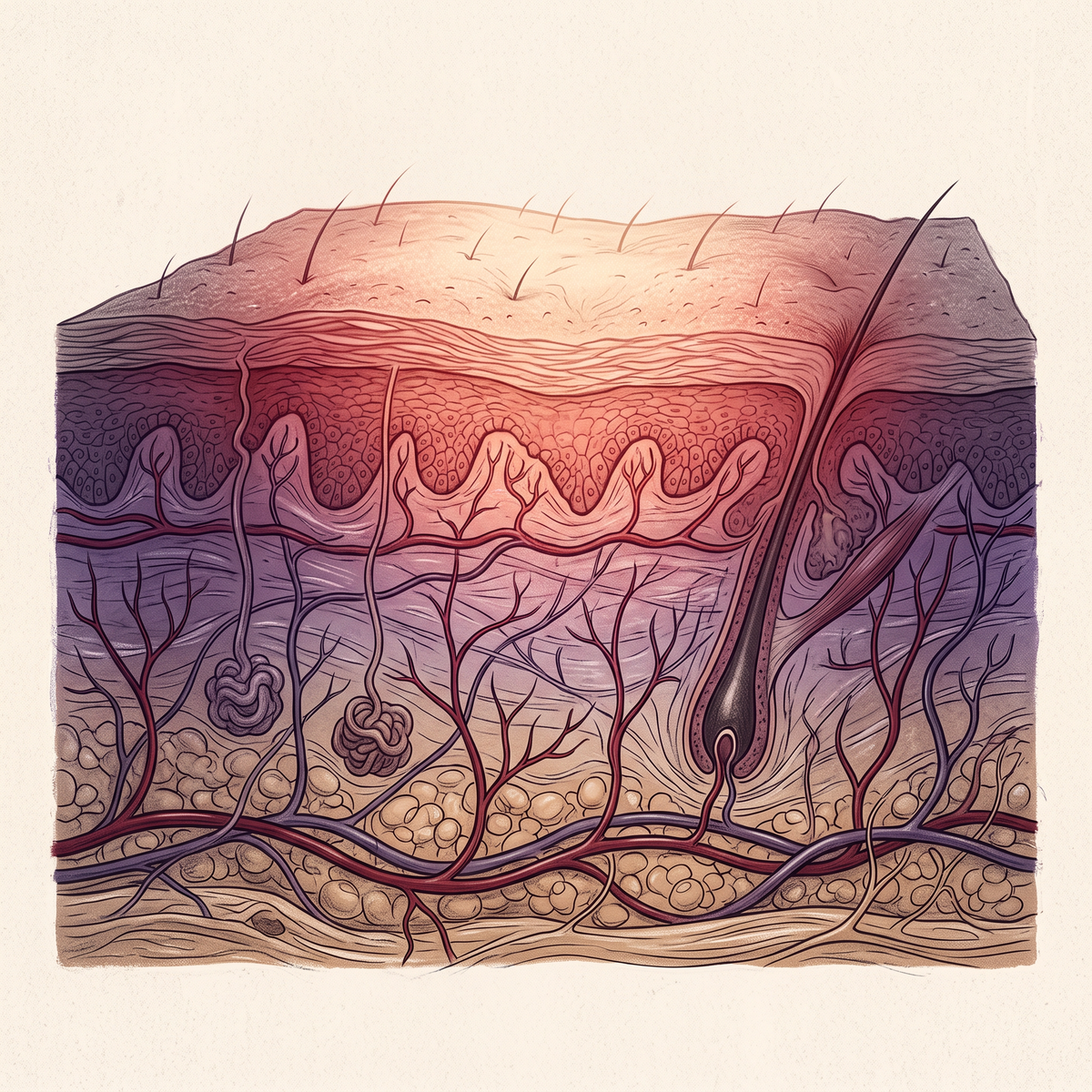
Near-infrared is invisible to the human eye — the panel looks the same whether it's running or not. It passes further into the tissue, which is what makes it the relevant wavelength for tendon and joint rather than skin.
What the light is doing
Light your blood can carry.
Red and near-infrared light are absorbed by mitochondria, where they may support ATP production — the energy cells use for ordinary repair.
Research also links this light to local microcirculation: more blood through the small vessels near the surface, carrying oxygen in and waste out.
That is the mechanism as understood today, not a promise about your hands.
What to expect
Honestly, it depends.
This is the range people actually report, rather than the number that would sell best.
Week 1
Mostly, it just feels nice
Twenty warm minutes with the television on. Treat this week as building the habit rather than testing the product.
- A mild, even warmth — never hot
- No stinging, no burning
- A few people notice easier mornings
- Most don't yet, and that's normal
Weeks 2–4
The window most people describe
If something is going to shift, this is usually where people say it started.
- Less stiffness in the first hour of the day
- Less catching and locking
- Grip that holds a little longer
- Hands that feel like they belong to you
Month 2–3
A habit, not a treatment
By now it's part of the evening rather than something you're evaluating.
- You stop thinking about doing it
- The difference shows up when you skip a week
- It lives on the arm of the chair
- Often moves to a knee or an elbow too
Month 6+
Or it isn't for you
Some people never notice a difference. We would rather put that here than bury it.
- Nothing about this works for everyone
- Ninety days is longer than most people need to know
- Send it back if it's in a drawer
Specification
Next to what most people already own.
Most people arrive here already owning a brace or a compression sleeve. Those hold a joint still; they don't put anything into it. This is what changes.
| Specification | Solera | A compression brace |
|---|---|---|
| Light therapy | 80 LEDs — 660nm + 850nm | None |
| Irradiance | 70 mW/cm² | — |
| Coverage | Palm and back of the hand at once | Compression only |
| Session | 20 minutes, shuts itself off | Worn for hours |
| Also fits | Wrist, elbow, knee, foot | One joint |
| Rechargeable | Three sessions per charge | — |
Research
What the literature actually says.
Photobiomodulation has been studied for decades. Here is a fair summary of where the research sits — including where it is thin.
The mechanism is settled
High evidenceRed and near-infrared light are absorbed by cytochrome c oxidase in the mitochondria, increasing ATP availability. This is the basis of photobiomodulation and it is not seriously disputed.
Light reaches the tissue
High evidenceThat 850nm penetrates further than 660nm is measurable, repeatable physics — which is why a device aimed at joints rather than skin uses both.
Hand and knee osteoarthritis
Moderate evidenceSeveral controlled trials report reduced pain and stiffness. Sample sizes are small and protocols vary enough that effect sizes are hard to compare.
Tendon and soft-tissue overuse
Moderate evidenceReasonable support for tendinopathy, mostly from clinic-grade devices under supervision rather than home units.
Carpal tunnel and nerve symptoms
Moderate evidenceEarly trials point consistently in the same direction, but participant numbers are small and follow-up is short.
Dose: how much, how often
Emerging evidenceIrradiance, duration and frequency are the least settled part of the field. Twenty minutes at 70 mW/cm² sits inside commonly studied ranges rather than being derived from a trial of its own.
The drawer test.
Here's the fear, and we'd rather name it than pretend it isn't there: you buy a device like this, use it four times, and it ends up in a drawer next to the massage gun.
So the ninety days aren't a formality. They're long enough to actually find out — most people who notice something notice inside a month, and most people who won't have worked that out by then too.
If it's in the drawer at day eighty-nine, send it back and we'll refund it.
Clinical opinion
What practitioners say about it.
Three clinicians who have used or recommended this device, in their own words.
What I like about this glove is that it delivers photobiomodulation directly across the hand and wrist, where many repetitive-use conditions develop. Red and near-infrared light may support mitochondrial activity and ATP production, giving cells more energy for normal repair processes. That may help reduce stiffness and discomfort associated with conditions such as carpal tunnel syndrome, trigger finger, and De Quervain's tenosynovitis. I also appreciate the design, because it provides consistent coverage around the fingers, thumb, palm and wrist rather than treating only one small area. I share it with patients as a convenient, noninvasive option that can complement stretching, activity modification and splinting.

One of the biggest challenges with hand therapy is finding something patients can realistically incorporate into their daily routine. I like Solera's glove because it offers a comfortable, noninvasive way to care for tired, stiff or overworked hands at home. Red and near-infrared light may help support cellular energy and the body's natural recovery processes, which can be valuable when the tendons, joints or surrounding soft tissues are irritated. I have recommended this type of therapy as an adjunct for patients managing trigger finger, carpal tunnel symptoms and mommy thumb. The wraparound design is especially appealing because the light reaches multiple parts of the hand and wrist in one session.
Many of the hand conditions I treat involve irritation of the tendons, tendon sheaths, nerves or surrounding soft tissues. I like Solera's glove because light-based therapy may help support healthy microcirculation and a balanced inflammatory response in these areas. That may be beneficial for patients managing discomfort associated with trigger finger, carpal tunnel symptoms or general overuse. The glove format is particularly useful because it surrounds the hand and delivers light to several areas at once. With regular use, most of my patients have noticed improvements in comfort and movement within a few weeks.

From people using it
Ten thousand hours of quiet evenings.
4.8/5.0 from 500+ verified users
My arthritis pain is noticeably better — much less stiffness after a few weeks of using it. Being able to do both hands is a big plus.
I use it after workouts and the difference in how my hands recover is significant. The soothing warmth is exactly what I wanted.
I noticed a difference in circulation within the first week. Easy to swap between hands, and the rechargeable battery makes it convenient.
I had tendonitis in both hands and this has helped a great deal. The warmth and the red light together work well for me.
Bought it for my mum, who has arthritis. She uses it on both hands and the swelling has gone down noticeably.
Lightweight, simple to use, and just the right amount of warmth. Less joint pain in both hands since I started using it regularly.
It's part of my daily routine now. It helps with the soreness I get from typing all day, and it's easy to alternate hands.
Excellent for recovery after training. My hands feel far better afterwards, and using it on either hand makes it versatile.
A good alternative to hand physio for me. Easy to switch between hands and the battery lasts several sessions.
This helped me through recovery after a hand injury. Straightforward to use and to recharge.
In the box
Including the part everyone forgets.
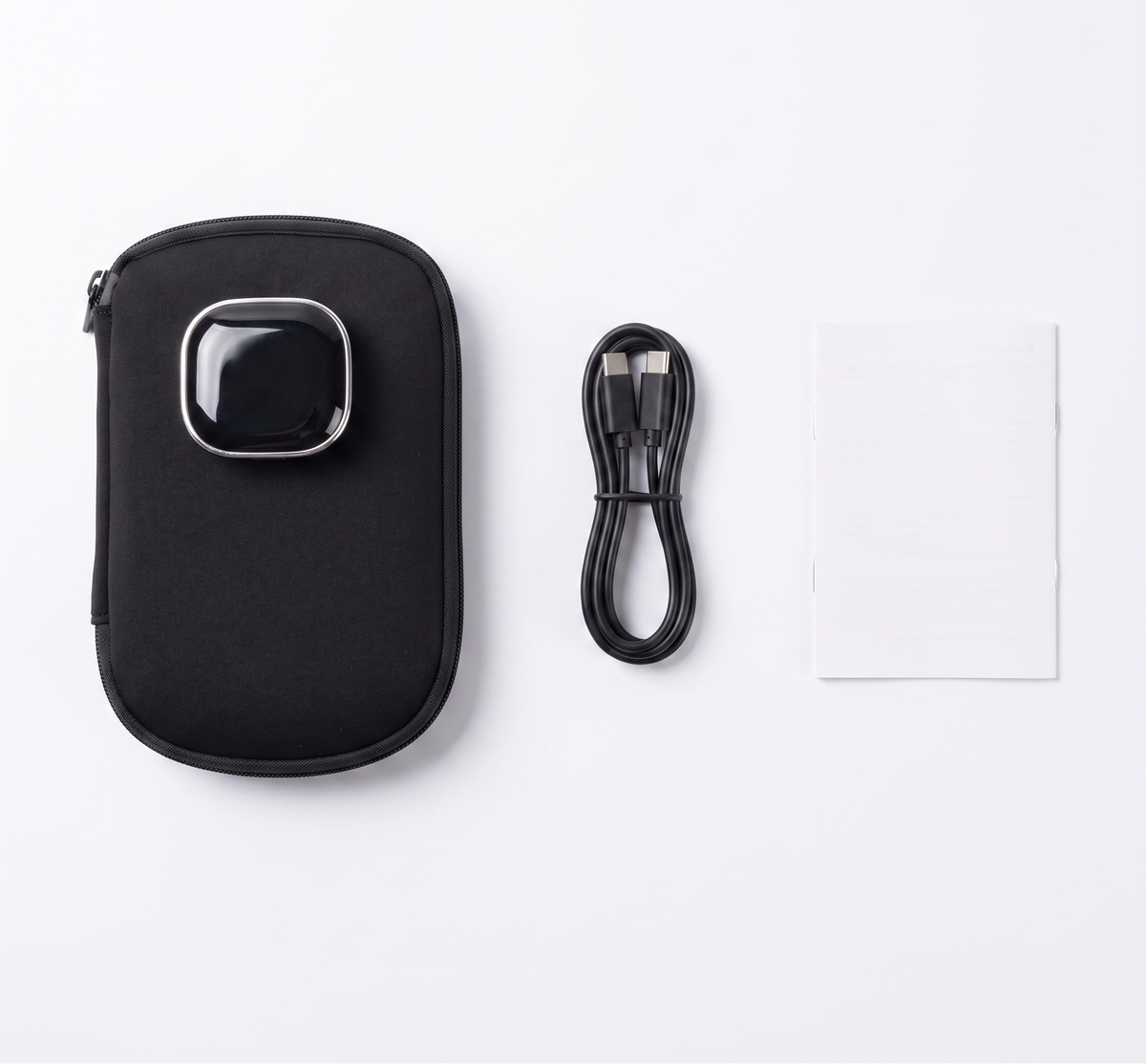
- The mitt80 LEDs, ambidextrous
- Control podDetachable, replaceable
- USB-C cableAny phone plug works
- Solera HandbookIncluded as free digital gift
- Wall plugBecause it's annoying without one
- Printed guidePlain English, no app needed
Questions
The things people ask first.
How long until I notice anything?
It varies more than we would like. Some people describe a difference after a single session. Most talk in terms of two to four weeks of near-daily use. And some people notice nothing at all — which is the reason for ninety days rather than thirty.
Does it get hot?
It gives off a mild warmth and should never feel uncomfortable. The inner lining stays cool enough to touch throughout. If heat is specifically what you want, a heating pad costs a fraction of this and does that job better.
Can I really use it on a knee or an elbow?
Yes — that's what the zip is for. Opened fully it lays flat, so it drapes over a knee, wraps an elbow, or slides over a foot. This came up so often from owners of similar devices that we treat it as a main use rather than a bonus.
Will it fit my hand?
One size, ambidextrous, with room for large hands. It covers from the fingertips to past the wrist, and further up the forearm if you make a fist.
How long does the battery last?
About an hour per charge — roughly three twenty-minute sessions. After a year of heavy daily use you'll notice it holding less. The control pod detaches, so that's the part to replace rather than the whole device.
I need it for both hands. Do I need two?
Not necessarily. Plenty of people do one hand then the other, forty minutes in total, usually while watching something. But wanting a second one is the single most common thing owners of devices like this say, which is why the two-pack is priced the way it is rather than as a full second unit.
Is it safe for my eyes?
Don't look directly into the LEDs. Zipped closed with your hand inside there's nothing exposed. Open and laid flat, the panels face outward. As with other red light products, it is safe to use, but you shouldn't stare directly into the light.
Will it help my specific condition?
We genuinely don't know, and neither does anyone selling you one. The research on red light for hands specifically is thinner than the marketing in this category suggests.
What we can say is that it's a drug-free thing to try for twenty minutes a day, it has ninety days behind it, and plenty of people who'd exhausted braces and heat found it worth keeping. That's the honest pitch.
Twenty minutes. Most days.
Nothing to strap on, nothing to plug in, and it turns itself off.